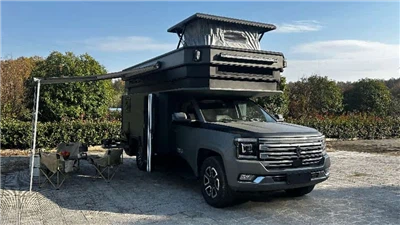






The working principle of the off-road RV mainly includes the following aspects:
Lightweight design: The off-road RV adopts a lightweight design, using a special lightweight plate for the RV as the body material, and the weight of the vehicle is reduced by 5%. By removing the traditional B-type RV bottom panel, the body structure is further optimized, and high-strength alloy aluminum materials are used in the installation of structural parts and the parts that need to be strengthened. This design not only ensures the stability of the body structure, but also avoids the performance degradation caused by excessive weight, and improves the fuel economy and passability of the vehicle.

Equipment layout: All weights and key components are strategically placed to maintain a stable center of gravity while the vehicle is in motion. By optimizing the chassis design, selecting lightweight and high-strength materials, and rationally arranging the superstructure of the vehicle, the center of gravity of the vehicle is reduced. This design makes the vehicle more stable when driving in difficult terrain, able to cope with greater angular tilts and bumps, and maintains excellent handling performance.
Power system: Off-road RVs are usually equipped with high-performance engines, such as the new generation of F1C-3.0T engine, with a peak power of 132KW and a peak torque of up to 430N.m, which ensures the vehicle's acceleration ability and passability in various road conditions. In addition, the triple locks (central differential lock with front and rear differential locks) ensure excellent traction and stability in all road conditions.
Off-road configuration: professional off-road axle design, front axle load capacity of 2.07T, rear axle load capacity of 3.2T, to ensure the vehicle carrying capacity. These configurations make the vehicle more efficient and smoother to maneuver in complex terrain scenes.
Material selection: Alloy aluminum has excellent characteristics such as light weight, high strength and corrosion resistance, which is very suitable for vehicles that need to withstand complex road conditions and harsh environments such as off-road RVs. The application of this material not only ensures the stability of the body structure, but also avoids the performance degradation caused by excessive weight.